


Pollution Under Control (PUC) Certificate for your Car
Managing automobile emissions is a major concern due to the growing number of vehicles on the road. The Pollution Under regulatory (PUC) certificate is a strong regulatory mechanism put in place by the Indian government. The PUC certificate, which is required by the Central Motor Vehicle Rules of 1989, guarantees that automobiles adhere to approved emission levels, fostering environmental sustainability.

An official document that attests to a vehicle's emissions being below the allowable limits established by pollution control agencies is called a Pollution Under Control (PUC) certificate. It is released following a comprehensive examination of exhaust emissions from the car. The following information is included in the PUC certificate:
- Certificate Number: A special number for monitoring the exam outcomes
- Vehicle Registration Number: The official registration information for the car
- Emission Test Results: Pollutant values, including hydrocarbons (HC) and carbon monoxide (CO)
- Test Date and Expiration Date: Details about the date of the test and the validity of the certificate
- The name of the approved testing facility is the issuing authority.
Why is PUC Certificate Important?
Here are the reasons for the importance of PUC Certificate as follows:
1. Legal compliance
All car owners are required by the Motor Vehicle Act of 1988 to have a current PUC certificate. There are fines of Rs.1,000 for the first offense and Rs.2,000 for successive infractions if this document is not produced during traffic inspections
2. Preservation of the Environment
Global warming and air pollution are largely caused by vehicle emissions. By ensuring that cars adhere to emission regulations, routine PUC testing lessens their negative effects on the environment
3. Renewing Insurance
According to the Insurance Regulatory and Development Authority of India (IRDAI), renewing auto insurance policy requires a current PUC certificate
4. Vehicle Health Inspection
The PUC test provides information about the fuel efficiency and engine health of your car. It guarantees prompt maintenance and enhancing car performance.
When is a PUC Certificate Required?
Here are the following reasons as follows:
- New Vehicles: A one-year PUC certificate is issued at the time of purchase
- Periodic Renewals: The certificate must be renewed every six months for cars older than a year. There are regional differences, too, such in Delhi, where the validity period is three months
- Post-Emission Test Failure: The certificate is revoked, and a new test is required if emissions above allowable limits during routine inspections.
Validity of PUC Certificate
The details about the validity of PUC certificate:
- New Vehicles: For new cars and two-wheelers, the PUC certificate provided by the dealers is valid for one year from the registration date.
- Renewal Requirement: After one year, vehicle owners must renew the PUC certificate per government guidelines.
- Validity for Older Vehicles: Vehicles older than five years receive a PUC certificate valid for six months.
- Adverse Emission Readings: If emission levels exceed limits, the certificate's validity period depends on the recorded readings.
How To Get a PUC Certificate Online?
The steps to get a PUC certificate online are mentioned below:
- Go to the Parivahan Sewa official website
- Choose the PUC Certificate option
- Enter the necessary information, such as the chassis number (last five digits) and the vehicle registration number
- Check out and get your PUC certificate.
How to get a PUC certificate offline?
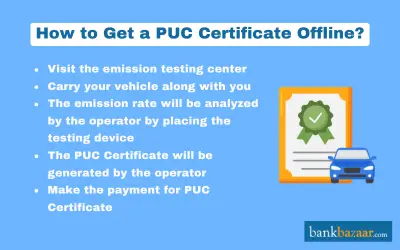
The steps to receive PUC certificate offline are mentioned below:
- Go to a nearby PUC testing facility that has been approved; these are typically found in gas stations or Regional Transport Offices (RTOs)
- A technician uses a gas analyzer attached to the exhaust pipe to measure the emissions from your vehicle
- A PUC certificate is given if the vehicle satisfies the emission of regulations. The document has a six-month validity period and contains the test findings.
Documents Required for Online PUC Application
All you will need to apply for a PUC certificate online is your vehicle’s Registration Certificate (RC) and your Aadhaar card for identity verification. Ensure that all the details across your documents match official records.
Vehicle Emission Test for Issuing PUC Certificate
The following are the steps to issue PUC certificate after vehicle emission test:
- Visit the emission testing center along with your vehicle
- Position the vehicle as per instruction
- Device will be inserted in the exhaust pipe by the testing center operator
- Exhaust emission can be analysed by starting the vehicle
- The readings will be displayed on the computer screen
- PUC certificate will be generated by the operator by clicking picture of the registration plate
- Make the payment to obtain the certificate
How to Find Nearby Centers for a PUC Certificate?
Follow these steps given below to locate the nearest PUC certificate centres:
Step 1: Visit the official VAHAN website: https://vahan.parivahan.gov.in
Step 2: Click on the "PUC Centre List" option.
Step 3: Select your state and the nearest RTO office from the drop-down menus.
Step 4: A list of authorized PUC centers will appear, along with their addresses and contact details.
Penalty for Not Obtaining PUC Certificate
Vehicles aught without PUC certificate will have to pay penalty and here are more details about it:
- PUC Certificate Requirement: As per the Motor Vehicles Act, 1988, every vehicle owner in India must have a valid PUC certificate along with motor insurance, registration certificate, driving license, and tax token.
- Penalty for Non-Compliance: Under Section 190(2) of the MV Act, individuals not having a PUC certificate will have to pay a penalty of Rs.1,000 fine if they are caught without PUC certificate for the first time.
- Repeat Offences: Subsequent violations attract a Rs.2,000 fine each time.
How to Renew PUC Certificate for Vehicles?
The details about the PUC certificate renewal for vehicles are mentioned below:
- Purpose: A PUC certificate ensures that your vehicle emissions are within permissible limits.
- Visit an Emission Testing Center: Take your vehicle to the nearest authorized emission testing center along with your Registration Certificate (RC) and previous PUC certificate.
- Emission Testing: The operator will check the pollutant levels using a gas analyzer.
- Wait for the Test Results: The system will generate readings for Carbon Monoxide, Hydrocarbons, and Smoke Density. These readings are compared to the prescribed limits based on vehicle type, fuel type, and age.
- Results: If your vehicle emissions are within the prescribed limits, then the PUC certificate will be generated immediately.
- Pay the Fees: One the procedure is completed; you will have to pay the fee for a PUC certificate.
PUC Test Procedure:
In the case of diesel vehicles, the accelerator is fully pressed and the readings of pollution levels are observed. This is repeated five times and the average constitutes the final reading. For petrol vehicles, the car is kept idling without pressing the accelerator. Only one reading is taken and this constitutes the final reading.
Pollution Certificate Permissible Limits
The details about the permissible limits for obtaining PUC Certificate are mentioned in the table below:
For New Cars
Vehicle Type | Hydrocarbon (in PPM) | Carbon Monoxide (in %) |
BS6 and BS4 four-wheelers (CNG/LPG) | 500 | 0.5 |
BS6 and BS4 four-wheelers (Petrol) | 200 | 0.3 |
For Older Vehicles
Vehicle Type | Carbon Monoxide (in %) | Hydrocarbon (in PPM) |
Pre-BS II Vehicles | 3 | 1500 |
Post-BS II Vehicles | 0.5 | 750 |
PUC for Old Vehicles:
In India, it is mandatory for all the vehicles to have a PUC certificate, irrespective of their age. The PUC certificate is valid for a period of six months after the vehicle’s first year.
The permissible emission limits for cars older than a year, are as given below:
Manufacturing Year of the Car | % of Carbon Mono-oxide | Hydrocarbon Measured in PPM |
4-Wheeler manufactured according to Pre Bharat-Stage II Norms | 3 | 1500 |
4-Wheeler manufactured according to Pre Bharat-Stage II and Subsequent Norms | 0.5 | 750 |
Manufacturing Year of the Bike | % of Carbon Mono-oxide | Hydrocarbon Measured in PPM |
2-Wheeler (2/4 stroke) manufactured before 31st March 2000 | 4.5 | 9000 |
2-Wheeler 2 stroke manufactured after 31st March 2000 | 3.5 | 6000 |
2-Wheeler 4 Stroke manufactured after 31st March 2000 | 3.5 | 4500 |
The permissible emission limits for bikes older than a year are as given below:
Manufacturing Year of the Car | % of Carbon Mono-oxide | Hydrocarbon Measured in PPM |
4-Wheeler manufactured according to Pre Bharat-Stage II Norms | 3 | 1500 |
4-Wheeler manufactured according to Pre Bharat-Stage II and Subsequent Norms | 0.5 | 750 |
Manufacturing Year of the Bike | % of Carbon Mono-oxide | Hydrocarbon Measured in PPM |
2-Wheeler (2/4 stroke) manufactured before 31st March 2000 | 4.5 | 9000 |
2-Wheeler 2 stroke manufactured after 31st March 2000 | 3.5 | 6000 |
2-Wheeler 4 Stroke manufactured after 31st March 2000 | 3.5 | 4500 |
What are the Details Mentioned in a PUC Certificate?
The details given in a PUC certificate are mentioned below:
- Certificate Number: A unique identification number assigned to the certificate.
- Vehicle Registration Number: The official registration number of the vehicle.
- Date of Test: The date on which the emission test was performed.
- Test Reading: Recorded pollutant levels (CO, HC, CO2, O2) based on vehicle type and regulations.
- Emission Norms: Standards the vehicle adheres to (e.g., BS4, BS6).
- Validity: The duration for which the certificate remains valid (typically 6 months to 1 year).
- Issuing Authority: Details of the authorized center that conducted the test.
- Vehicle Information: Includes make, model, fuel type (petrol, diesel, CNG), and engine type.
Rules for PUC Certification:
Here are the details regarding the PUC certification rules:
- Standardized PUCC Form: As per G.S.R. 410(E) dated 14 June 2021, the Ministry has introduced a uniform PUCC format applicable nationwide under the Central Motor Vehicle Rules, 1989.
- PUC Data Linkage: G.S.R. 527(E) dated 6 June 2018 mandates linking PUC data with the VAHAN database.
- Certificate Requirement: Rule 115(7) of CMVR, 1989 states that vehicles must have a valid "Pollution Under Control" certificate after one year from the date of first registration.
- Certificate Validity: The PUC certificate is valid for six months, while vehicles meeting BS-IV or BS-VI norms have a validity of twelve months.
- PUC Certificate Regulations: Vehicle owners must carry a valid PUC certificate and present it upon request by authorized officers.
Advisory for State Governments
- PUC Centre Mandate: Each fuel station must have a PUC testing centre.
- Machine Calibration: Regular calibration of PUC machines must be done by authorized third-party agencies.
- Random Inspections: Transport Departments must conduct random checks and enforce PUC compliance.
- Pre-Payment of Fees: PUC fee payment must be made before conducting the test.
- Mobile Test Centres: Well-equipped mobile testing units should be introduced for monitoring visibly polluting vehicles.
- Penalties for Non-Compliance: Strict penalties, including cancellation of authorization, should be enforced for PUC centres engaged in malpractice.
- Implementation Responsibility: The enforcement of the Motor Vehicles Act, 1988, and CMVR, 1989, falls under the jurisdiction of State and Union Territory Governments.
Tests Conducted During A PUC Check
- Carbon Monoxide (CO) Test: Assesses fuel combustion efficiency by measuring CO levels
- The hydrocarbon (HC) test evaluates the amount of unburned fuel particles in the exhaust
- The Smoke Density Test measures the amount of smoke that diesel engines release
- Idling CO Test: Measures CO emissions while the car is not moving
- The CNG/LPG Soundness Test finds leaks in cars that run on alternative fuels.
What Happens if the PUC Certificate is Expired?
Here are the important points that should be remembered if the PUC certificate is expired:
- Legal Requirement: Carrying a valid PUC (Pollution Under Control) certificate is mandatory, as per Section 190(2) of the Motor Vehicles Act, similar to a motor insurance policy.
- Penalties for Non-Compliance: If found without a valid PUC certificate or carrying an expired one, traffic authorities have the right to impose fines and even seize the vehicle.
- PUC Renewal and Rejection: During renewal, if a vehicle's emissions exceed permissible levels, the testing center may issue a rejection slip, thereby restricting its use.
Benefits of a PUC Certificate
Here are the benefits of a PUC certificate as follows:
- Required Compliance: A PUC certificate guarantees compliance with traffic regulations, shielding you from penalties and legal problems
- Control of Pollution: Accreditation helps create a cleaner environment by reducing vehicle emissions
- Requirements for Insurance: It is not feasible to renew auto insurance policies without a current PUC certificate
- Health of the Engine: Early detection of engine problems through emission tests aids in maintaining peak performance.
FAQs on Pollution Under Control Certificate
1.What should I do if I lose my PUC Certificate?
You can retrieve or download your PUC certificate by visiting the Parivahan portal, in case you have lost your vehicle’s PUC certificate.
2.Do I need to obtain a pollution certificate for a new car?
Yes, you need to have a PUC Certificate for your new car, which is generally issued by the vehicle dealer and is valid for a year.
3.Can I renew the PUC Certificate before the expiry date?
Yes, you can renew your vehicle's PUC Certificate before expiry date to avoid paying penalties in case caught while driving without PUC certificate.
4.Is the Pollution Under Control Certificate valid all over India?
Yes, the PUC Certificate issued to the vehicle is valid across the country.
5.What is the grace period for PUC Certificate renewal?
The grace period offered for Pollution Under Control Certificate renewal is seven days from the expiry date of the PUC certificate of the vehicle.
6.What type of vehicles requires a Pollution Under Control Certificate in India?
Vehicles running on (ICE) Internal Combustion Engines, such as petrol, diesel, Compressed Natural Gas (CNG), or Piped Natural Gas (PNG), need to have a Pollution Control Certificate in India.
7.Can I get the PUC Certificate for my vehicle in another state?
Yes, you can obtain the PUC certificate for your vehicle from another state no matter whether your vehicle belongs to that particular state or not.
8.Who has the authority to conduct a Pollution Under Control test?
The PUC tester must hold a recognised degree in motor mechanics or automobile engineering and be able to perform minor adjustments to reduce emissions without affecting engine performance.

Disclaimer
Credit Card:
Credit Score:
Personal Loan:
Home Loan:
Fixed Deposit:


Copyright © 2026 BankBazaar.com.